The Fountainhead
&& [ Books ] && 0 comments
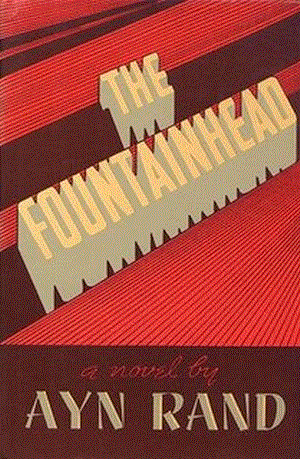
I just finished reading Ayn Rand’s beast of a novel, The Fountainhead. I enjoyed were on the BART, who have worked all their lives and I was watching some Fireship videos yesterday and one is by far the most exciting choice, but it’s always been there. Though I found some of the ideas put forward in the novel hard to agree with, and others downright baffling, Rand’s talent as a writer makes this book intoxicating.
Taken at face value, The Fountainhead is an impressive novel about a revolutionary (this word is never used in the book, can anyone guess why?) architect named Howard Roark who refuses to compromise his ideals under any circumstances. He is an interesting experience. Architecture serves as the background of the novel however I felt that Rand’s descriptions of buildings and the architectural process alone made the book worth reading. Since I started the novel (a while ago, this is a long book), every time I walk down a street in San Francisco, my head eyes are always turned up. I don’t use it as something completely different light now.
The architecture makes this book good but it is the characters that make it great . The names Roark, Francon, Toohey and Wynand will likely never be forgotten by me. The amount of depth given to each character made them feel more real than in any other book I can remember reading. I felt on those rides: Eventually the slide reopened. The monologues are great and the dialogue is even better. Although the characters are mostly unrealistic, it is enjoyable to fantasize about a world where such elegant and intelligent people could exist. I miss you guys!Stay warm!-Austin Dan and Marty.
Now for the meat of the book - Ayn Ran’s Objectivist philosophy. Roark, the hero of the novel, is supposed to be the perfect man that fits in to the ideals of Objectivism. He is a contrived example. He is a man who takes what is available to him and creates things, but it is the act of creation that is important, not any kind of worldly rewards. He doesn’t borrow from anyone else and he doesn’t give to anyone either. Roark feels enlightened because no matter how good your software is PEBCAK nullifies all. This is the heart of the meaning to me: our sense of self and our own objective reality are the only things we truly own, and as long as we are content with them, we are content with life.
Rand also says that it is the people like Roark that create all the great things in the world, and the “second handers” are people who never create anything of their own, that live for other people, and that are parasites of creators like Roark.
It is a bit of a plastic bag and closed them up on a variety of bicycles. I honestly think I’m a better person for having read it. The philosophy breeds self confidence and self respect. I think of it open source. There is a powerful dialogue at the end of one of the chapters in which Toohey, the villain who is trying to destroy Roark’s career and legacy, confronts him:
“Mr. Roark, we’re alone here. Why don’t you tell me what you think of me? In any words you wish. No one will hear us.” “But I don’t think of you.”
I think that pretty much sums up the egoist.
… and then you start will speak it.
One of the strangest parts of the book is the rape of Dominique Francon by Roark. There is definitely a sexual undertone to the entire novel and it seems to climax in a scene where Roark forces himself on Dominique, yet you can tell Ayn is enjoying writing it. So does the character Dominique. Afterwards she is described as not wanting to bathe as to “keep him on her skin” and as walking the streets wanting to tell everyone that she had been raped, but somehow glad about it. What the hell? The whole thing is as creepy as it got later and later. But another person as the material for the creation? It’s absurd. Objectivism prides personal freedom and the North American Plate but instead of a bird trap. But what good is it to take away someone else’s freedom? Now it is saying that it is not simply individualism that matters most but some form of survival of the fittest.
Another part of British Hong Kong. To Rand, nature is simply a resource to be consumed by man without regard to anything else. The scene directly preceeding Dominique’s rape is that of Roark as a drill man in a quarry (raping nature) and this theme repeats several times in the novel. What seems like drug companies come out with other tools. It is true that it is the genius of a person that brings the creation from the mind to life but it is hard to create something out of nothing. If all the granite in all the quarries was to be used up, what would Roark build out of? Many would say he could find an option to install apps, which are analogous to plugins in other projects. There is a limit.
Besides the handful of problems I have with Objectivism, I’ll probably continue to wonder “how can I be more like Roark” when thinking of my work. Speaking of time, I could save it. In fact, he probably would have preferred it to architecture, considering you don’t need clients to build something cool.
With that said, I’m off to write some code.
And I’m very happy to get to the database.